Many Google Maps articles make the same mistake.
They give you a list of tactics without helping you work out which one is actually holding the business back.
Owners then keep adding photos, chasing citations, and asking for more reviews while the business still loses the local pack.
The useful question is simpler:
- Why are the businesses above me outranking me right now?
If you cannot answer that, you do not have a ranking plan yet.
Short answer
If you want to rank higher on Google Maps, fix the signals that make Google trust the business as the best local answer for the search:
- category and service relevance
- realistic distance coverage
- prominence through reviews, mentions, and trust
- strong website support behind the profile
Google's own local ranking guidance still frames local visibility around relevance, distance, and prominence. It remains the right model.
What many businesses miss is that the website often acts as the hidden fourth constraint. A profile can look complete and still underperform if the landing page behind it is generic, thin, or weak on trust.
Start by separating ranking from visibility
Do not assume you have a ranking problem before you prove the profile is actually live and stable.
Search the exact business name and city while signed out of the account that manages the profile.
Then check:
- does the profile show for the exact brand search
- does it show in Maps but not in the local pack
- does it disappear after category, address, or website edits
- did the business move, merge, or rebrand recently
If the business is hard to find even by exact name, read why your business is not showing on Google Maps first.
If the business is still in the setup phase, start even earlier with how to get your business on Google Maps.
That problem is different from ranking below competitors for a service query.
What Google Maps rankings are really comparing
When Google decides which businesses to surface in the local pack, it is not rewarding whoever completed the most profile fields.
It is comparing whether the business looks like the strongest local answer for the search.
That comparison usually comes down to four questions:
1. Is the business clearly relevant to the query?
Google needs confidence that the profile matches what the searcher wants.
That comes from:
- the primary category
- sensible secondary categories
- listed services
- the business description
- the page on the site that supports the listing
2. Is the business realistically placed for the searcher?
Distance matters more than many businesses want it to.
If the search happens far from the real operating base, some visibility loss is structural. That is especially true for service-area businesses trying to rank evenly across a wide region.
3. Does the business look trusted and established?
Prominence shows up here:
- reviews
- review recency
- citation consistency
- local mentions
- strong third-party references
4. Does the website reinforce the profile or weaken it?
The website tells Google whether the business has a clear service page, useful local proof, and enough substance to justify stronger visibility.
If that page is vague, thin, or misaligned with the profile, the profile often stalls with it.
The audit framework I use before changing the profile
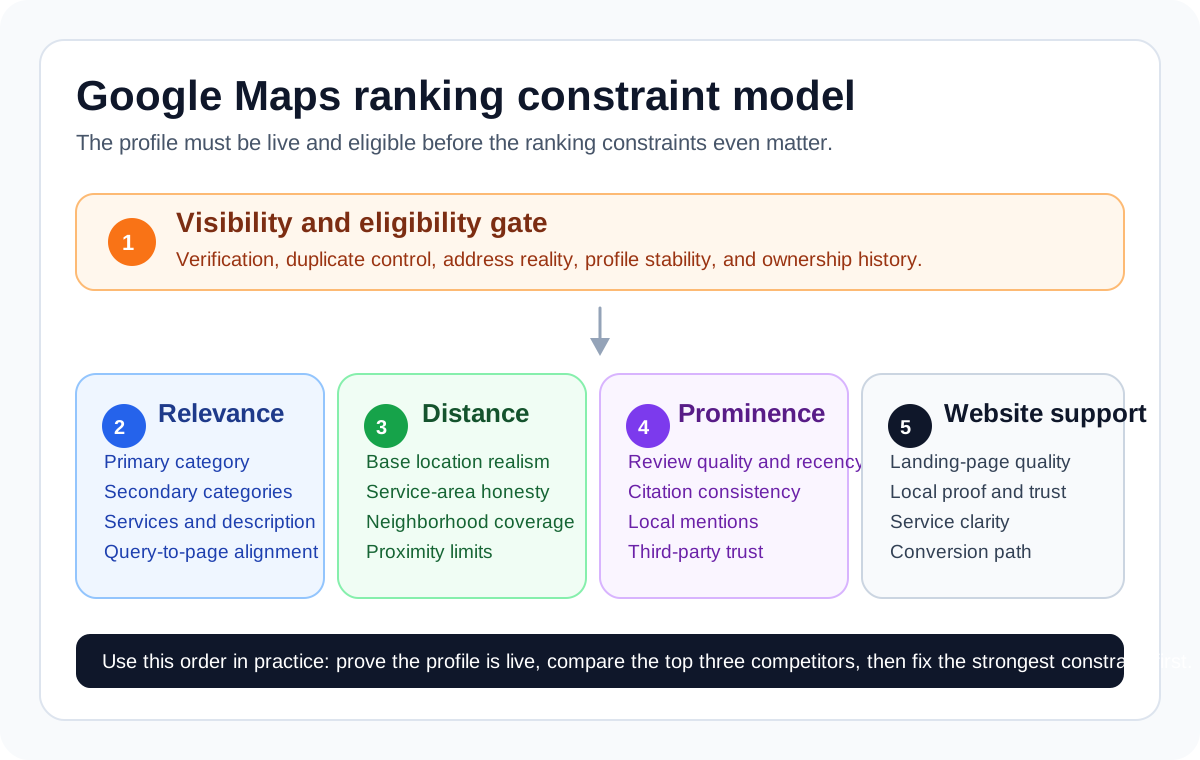
I do not start local audits by asking which tactic sounds popular this month.
I start by checking whether the profile is even through the visibility gate, then I compare the four constraints that usually decide the ranking gap:
- relevance
- distance
- prominence
- website support
That matters because many businesses try to solve a relevance problem with review work, or a website-support problem with citations, or a proximity problem with thin page sprawl.
The fix gets easier once the limiting constraint is clear.
What I would fix first
I would not start with the longest checklist. I would start with the biggest ranking levers.
1. Fix the primary category before almost anything else
The primary category is one of the clearest local relevance signals.
If it does not match the main revenue-driving service, the profile starts on the back foot.
I would compare:
- your current primary category
- the categories used by the top three local-pack winners
- the actual service you most want to rank for
The goal is not to copy competitors blindly. The goal is to stop sending a weaker category signal than the businesses you need to beat.
2. Tighten the page behind the profile
Many local SEO guides underplay this.
If the business profile points to a weak page, Google gets less support for the query.
The supporting page should do a few things clearly:
- name the service in the title and H1
- explain what the business actually does
- show proof that feels local and specific
- make the next step obvious
If the page reads like any other local landing page on the internet, it rarely helps much.
At that point, a local SEO consultant engagement usually becomes more useful than a pure profile cleanup.
The website is often the real difference maker
When businesses say, "My profile is complete but I still do not rank," I usually inspect the website next.
That page often has one or more of these problems:
- no strong local service targeting
- a generic H1
- weak or missing local proof
- no useful explanation of the area served
- no trust-building detail about the business
- poor conversion path after the click
That matters because Google Maps rankings do not live in a vacuum. If the website does not reinforce the local intent clearly, the profile has less support than it should.
Reviews help, but only in the right context
Reviews matter. They are not the whole ranking system.
I would look at:
- whether new reviews still come in
- whether the review language reflects the services you want to rank for
- whether the business responds consistently
- whether competitors have a much stronger review base
The mistake is treating review count like a magic number.
A business can have more reviews and still lose if the category is wrong, the distance gap is large, or the site support is weak.
What review work usually does best
Strong review systems tend to help in three ways:
- they keep the profile looking alive
- they strengthen trust beside competitors
- they improve conversion after the impression
Useful, yes. It is not a substitute for fixing the wrong page or the wrong category.
Prominence comes from more than reviews
Prominence is broader than star ratings.
I would check:
- whether the name, address, and phone are consistent across major references
- whether trusted local directories or associations mention the business
- whether local partnerships, sponsorships, or coverage exist
- whether the brand looks established on its own site
Many businesses discover here that Google does not have much public evidence to trust them relative to the local leaders.
That does not mean the business is weak.
It means the public proof is weaker than the private reality.
Distance is the hardest constraint to accept
Distance is also the easiest one to waste time fighting.
If the business serves a broad metro area, rankings will often vary by neighborhood, ZIP code, or block.
That variation is normal.
The wrong conclusion is:
- I should rank first everywhere.
The better conclusion is:
- I should understand where proximity is limiting the profile and where a better relevance or prominence setup can still move the outcome.
That is one reason I prefer honest local targeting over thin city-page sprawl.
Measure by area, not by one lucky search
A single search from your own office does not tell you much.
Location, device history, and account state distort local results quickly.
If you want a better diagnosis, compare:
- exact brand visibility
- the main service query
- a few nearby neighborhoods or ZIPs
- the top three businesses that keep appearing
Then ask:
- are they using a stronger category
- do they have better reviews or fresher review flow
- is their landing page better
- do they look more credible across the web
That comparison gives you a ranking hypothesis instead of a guess.
The competitor sheet I would fill out before changing anything
Before I change a profile, I want a simple comparison against the businesses already winning.
| Signal | Stronger local-pack winners usually show | Weaker profiles often show |
|---|---|---|
| Primary category | A category that matches the core money service closely | A broad or slightly off-target category |
| Landing page | A page with a clear service H1, specific proof, and an obvious next step | A generic page with weak local substance |
| Reviews | Recent reviews that reflect the right service language | Old reviews, weak review flow, or irrelevant review themes |
| Public trust | Consistent citations and recognizable local mentions | Inconsistent references and thin outside validation |
| Geographic fit | Strong visibility where the business can realistically compete | Visibility expectations far beyond the real base location |
This is not a full audit sheet. It is a fast way to stop guessing.
If the top three businesses beat you in the same column again and again, that column deserves attention first.
A practical 30-day improvement plan
If I were improving a struggling local profile without turning it into a six-month project on day one, I would do this:
Week 1: confirm the profile basics
- verify the profile is live and stable
- confirm the primary category
- clean up service details, hours, and business info
- check for duplicates, ownership issues, or move history
Week 2: strengthen the landing page
- rewrite the title and H1 if they are weak
- improve the opening copy so the service and market are obvious
- add clearer local proof
- check that the page supports a real next step
Week 3: review trust and prominence gaps
- compare review quality and recency with competitors
- improve review-response consistency
- fix major citation inconsistencies
- identify missing local references that competitors already have
Week 4: compare results by market segment
- recheck visibility in the areas that matter most
- confirm whether the business improved only near the base location or more broadly
- decide whether the next bottleneck is distance, proof, or page support
This is a much stronger starting sequence than changing everything at once.
Two ranking patterns I see repeatedly in local audits
These are not hypothetical checklist ideas. They are recurring patterns.
The profile looks decent, but the landing page is doing almost nothing
This pattern looks like:
- the business profile is live
- reviews are acceptable
- the category is close enough
- but the landing page says almost nothing specific about the service or market
In that setup, the profile often looks complete to the owner and weak to Google.
The page may have:
- a vague H1
- no local proof
- no explanation of the service area
- no reason for the search engine to trust that this business is the best answer
That is why I keep treating the website as part of local ranking work, not as a separate concern.
The business has reviews, but the category is still blunting the ranking signal
This pattern is common in service businesses with a broad offer.
The owner picks a category that feels accurate in general, but the businesses winning the local pack use a more commercially precise one.
Then the owner tries to close the gap with:
- more photos
- more reviews
- more profile edits
Those can help around the edges. They do not fix a weaker starting relevance signal.
That is why I compare the category choice against the actual winners early, before I spend time on lower-value polish.
What usually makes Google Maps rankings worse
I see a few patterns repeatedly.
Category churn
Changing categories too often without a clear reason creates noise instead of progress.
Thin location-page sprawl
Dozens of weak city pages often create more quality problems than ranking gains.
Fake offices or borrowed addresses
Fake offices are not a serious long-term local strategy. They are a trust problem waiting to happen.
Ignoring the website
If the site is weak, the profile often caps out below stronger businesses even when the profile itself looks tidy.
When a free tool is enough and when it is not
If you want a first-pass diagnosis, use the free local SEO audit tool.
It is designed to separate:
- profile visibility issues
- local relevance issues
- prominence gaps
- weak website support
If the business has multiple locations, move history, duplicate listings, or a weak site behind the profile, I would treat it as a broader local SEO consulting problem instead of trying to solve it with checklist work alone.
The main point
Ranking higher on Google Maps rarely comes from one hack.
It usually comes from fixing the most limiting constraint before you spend time on lower-value polish.
For one business that is category relevance. For another it is review quality. For another it is a generic service page that quietly weakens the whole profile.
The job is not to do more local SEO tasks.
The job is to work out which local SEO task matters first.
If you need the setup steps behind the profile itself, read the companion Google Business Profile optimization checklist.
FAQs
How can I rank higher on Google Maps fast?
The fastest improvement usually comes from fixing the wrong primary category, weak landing-page support, or obvious profile inconsistencies. Reviews and photos help, but they are rarely the only blocker.
Why is my business not ranking on Google Maps even though the profile is complete?
Because profile completeness is not the same as competitive strength. A complete profile can still lose on relevance, distance, prominence, or weak website support.
Does my website affect Google Maps rankings?
Yes. In competitive local markets, the page behind the profile often influences whether Google sees the business as a strong answer for the query.
Should I create more city pages to rank in more areas?
Not automatically. If the business does not have strong, legitimate reasons to own those pages, thin location-page sprawl can weaken the site instead of improving local visibility.