Independent international SEO consultant
International SEO consultant for multilingual growth, migrations, and AI search visibility
If your multilingual site is ranking in the wrong markets, showing the wrong language to the wrong users, or losing ground after a migration — the problem is usually structural, not a content gap. I help B2B SaaS and eCommerce companies fix the systems behind global visibility: market selection, search architecture, hreflang, localization, migration risk, and AI search readiness.
Technical SEO, hreflang, localization, migrations, and AI search visibility for SaaS, eCommerce, and multilingual websites.
Point of view
International SEO is a systems problem, not a translation project
Most international SEO problems do not happen because a website lacks translated pages. They happen because the system behind those pages is unclear.
A translated page can still underperform if it targets the wrong local search intent, sits inside the wrong URL structure, points to conflicting canonicals, uses broken hreflang references, or lacks the market-specific trust signals users need before they engage.
That is why I approach international SEO consulting as a connected system. Market opportunity, site architecture, technical language signals, localized content, internal linking, migration risk, measurement, and AI search visibility all need to support the same strategy.
Why it breaks
Where international SEO usually fails first
International SEO usually fails in the gaps between translation, technical setup, and local search behavior. A site can look multilingual on the surface while still sending mixed signals to search engines, users, and AI systems.
Translated pages with no local keyword research
Hreflang pointing to redirected, broken, canonicalized, or noindexed URLs
Missing hreflang return links between language versions
Canonicals and hreflang sending conflicting signals
URL structures that are too hard to maintain or scale
Duplicate templates that ignore local intent, terminology, and trust signals
Internal links pointing users and crawlers back to the wrong language version
Sitemaps containing old, redirected, or inconsistent international URLs
Migrations launched without redirect, canonical, hreflang, sitemap, and ranking QA
AI systems understanding the brand in one language but not another
Consultant note: The failure mode I see most often is a site that looks international — country flags, language toggles, translated content — but where the underlying signals are contradicting each other. The appearance of internationalization is there. The infrastructure that makes it work is not.
Framework
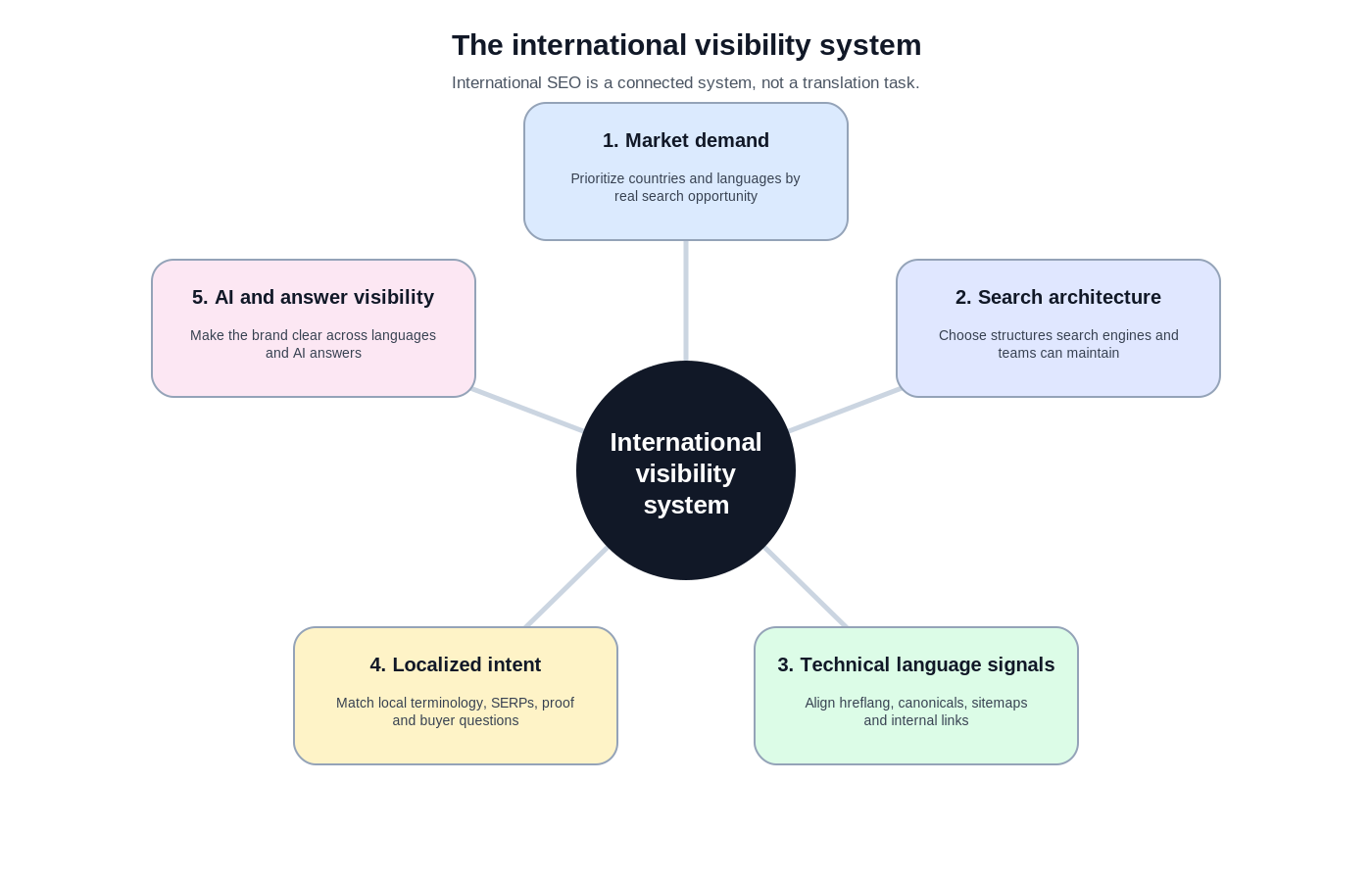
The international visibility system
Before recommending more pages, more translations, or more market expansion, I look at whether the foundations are strong enough to support visibility across countries, languages, search engines, and AI-driven discovery.
Market demand
Identify whether a market is worth targeting through local search demand, commercial intent, competitor patterns, SERP differences, and product-market fit.
Search architecture
Choose a structure that can scale cleanly across subfolders, subdomains, ccTLDs, language-only targeting, country targeting, crawl paths, and authority flow.
Technical language signals
Align hreflang, return links, x-default, canonicals, indexability, sitemaps, redirects, internal links, and language or region codes.
Localized intent
Match local terminology, metadata, trust signals, use cases, FAQs, and buyer expectations instead of relying on direct translation alone.
AI and answer visibility
Make local pages easier for search engines and AI systems to understand, summarize, compare, and cite across regions.
Translation, localization, international SEO, and AI visibility are not the same thing
These layers are connected, but each one solves a different problem. Treating them as a single task is one of the easiest ways to waste budget without improving international visibility.
Download the international SEO readiness checklist
Use this checklist before launching a new market or auditing an existing multilingual setup.
| Layer | What it does | Why it matters |
|---|---|---|
| Translation | Converts content from one language into another | Helps users read the page, but does not guarantee search relevance |
| Localization | Adapts wording, examples, proof, and expectations to a market | Helps pages feel relevant and trustworthy to local users |
| International SEO | Aligns market demand, URL structure, hreflang, canonicals, sitemaps, internal links, and measurement | Helps the right pages appear in the right countries or languages |
| AI search visibility | Makes content clearer, more consistent, and easier for AI systems to understand across markets | Helps the brand be interpreted and surfaced more consistently in answer-driven search |
Consulting services
International SEO consulting services
Most of my international SEO work involves B2B SaaS companies expanding into Europe and eCommerce brands managing migrations across multiple markets. The work is not simply to launch more country or language pages — it is to identify where visibility is breaking, decide which markets deserve investment, and build a structure that can scale without creating more search confusion.
International SEO strategy
Before recommending new pages or markets, I assess whether the existing structure can support growth. That means local demand research, commercial intent analysis, SERP differences by market, competitor positioning, and a clear view of whether the current URL architecture is worth keeping or worth changing.
Multilingual technical SEO
I audit the technical layer that makes or breaks international visibility: crawlability by market, indexation status, canonical logic, sitemap consistency, internal link paths, and how language or regional versions relate to each other. Most sites have more conflicts here than they realise.
Hreflang implementation and validation
Hreflang is easy to get wrong and hard to diagnose from inside a CMS. I check return-link completeness, language and region code accuracy, non-200 targets, noindexed URLs, canonical conflicts, and x-default logic — and document what needs fixing in a format your developers can actually act on.
SEO localization and search intent mapping
Translation changes the language. Localization changes whether the page earns traffic. I map local search intent, identify terminology gaps, review SERP format expectations, and recommend heading, metadata, and content changes that make pages feel like they were built for that market — not adapted from another one.
International SEO migration support
International migrations carry compounded risk: one redirect gap can break visibility across multiple markets simultaneously. I build the URL mapping, redirect plan, hreflang update plan, canonical and sitemap checks, and post-launch monitoring framework before the migration goes live — not after.
AI search visibility across markets
AI systems read your pages differently than users do. I review whether local pages are clear enough to summarize, whether entity and brand definitions are consistent across languages, and whether important market-specific questions are answered in a way AI systems are likely to surface.
International SEO reporting and monitoring
Visibility across markets is hard to track without the right setup. I build measurement frameworks segmented by country, language, page type, and conversion path — so you can see which markets are performing, where rankings are slipping, and what post-migration volatility looks like in practice.
Why hire me
Why companies hire me for international SEO
International SEO projects often involve developers, content teams, localization agencies, and product managers all working at the same time. My value is in making the SEO layer coherent across all of them — not just auditing and handing over a list.
Technical and structural range
I work across hreflang, canonicals, sitemaps, internal linking, and localized page structures. The strategy and the implementation spec come from the same person.
Grounded in real planning work
The recommendations here come from actual multilingual migration planning, hreflang audits, and localization QA — which means they tend to hold up when a developer asks how something should actually be built.
Strategy and execution planning
I can help teams work through structural decisions, language-market alignment, and implementation priorities with enough technical depth to translate that into a dev-ready spec.
Works across functions
I have worked in environments where SEO, content, product, and development all had competing priorities. Getting the international SEO layer to hold across all of them is something I have done before.
Technical international SEO
Technical international SEO signals need to work together
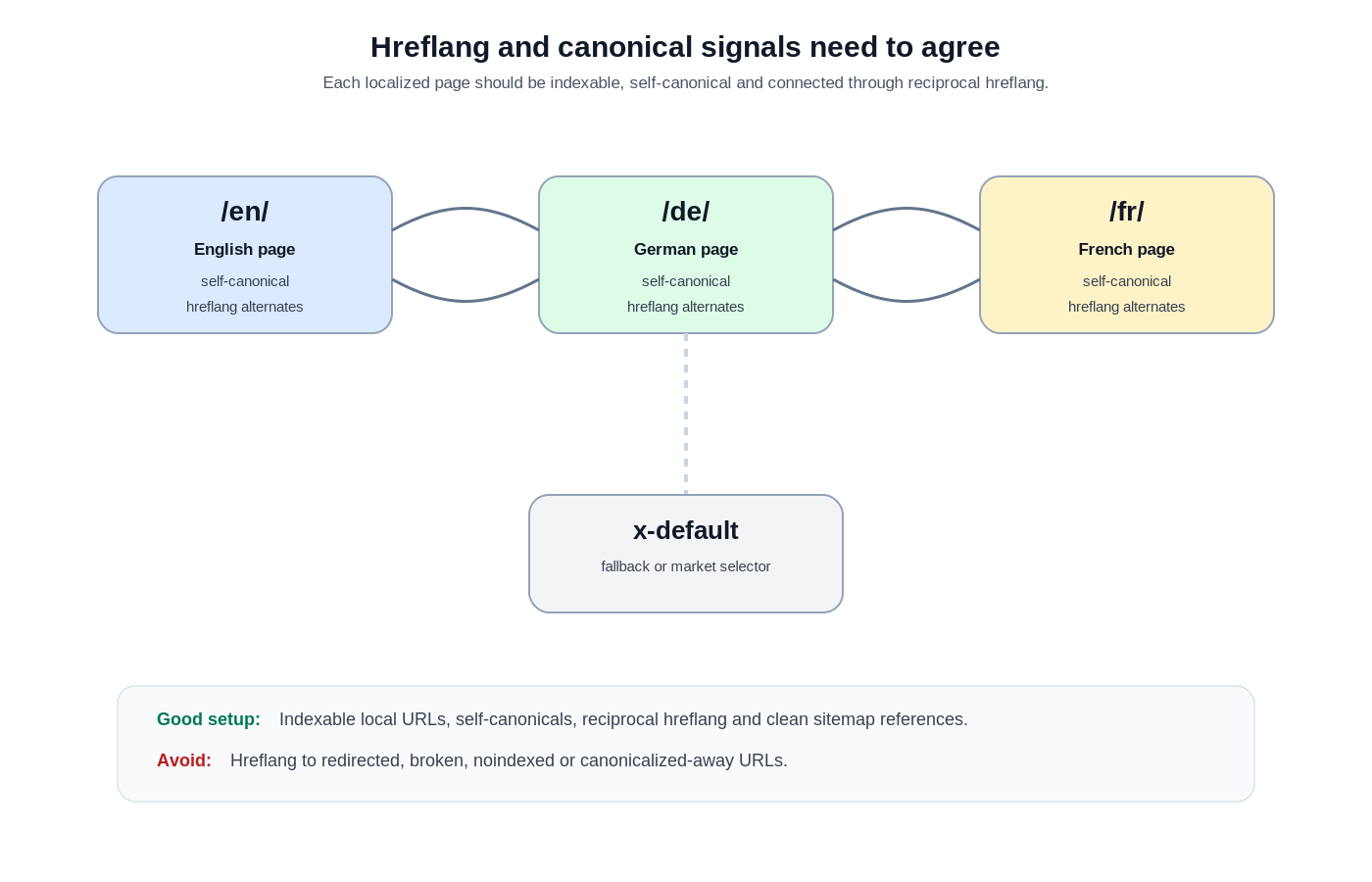
International SEO often breaks when technical signals contradict each other. A page may be translated, localized, and published, but if hreflang, canonicals, sitemaps, internal links, redirects, and indexation rules are not aligned, search engines may struggle to understand which version should appear for which audience.
The technical review usually overlaps heavily with technical SEO, but with a tighter focus on language and market targeting, international crawl paths, and how signals align across versions.
Hreflang return links and reciprocal relationships
x-default handling for global or fallback pages
Language and region codes
Canonical and hreflang alignment
Indexability and crawlability
XML sitemap consistency
Internal linking between market versions
Redirect chains, loops, 404s, and migration mappings
Duplicate localized URLs and template variants
URL structure options such as subfolders, subdomains, and ccTLDs
Crawl paths and page depth for international sections
Localized metadata, headings, and page templates
Measurement setup by country, language, path, page type, and conversion
Consultant note: Most hreflang implementations I audit have at least one error class that standard validation tools miss — usually a canonical conflict, a noindexed return link, or a gap between what the sitemap declares and what the page signals. The implementation looks complete. The signals are not aligned.
Localization
Localization beyond translation
Translation changes the language of a page. Localization changes how well that page fits the market. A page can be grammatically correct and still fail in search if it does not match local terminology, buyer expectations, competitor context, SERP patterns, or trust signals.
This is where SEO content strategy and international SEO overlap. Localized pages need structure, intent mapping, proof, and phrasing that feel native to the market instead of mechanically translated.
Local keyword research and search intent
Local SERP analysis and content format expectations
Local competitors, directories, publishers, marketplaces, and review sites
Market-specific terminology and buying phrases
Local trust signals such as currency, delivery details, compliance, testimonials, examples, and case studies
Localized titles, meta descriptions, H1s, H2s, and FAQs
Local examples, use cases, and buyer objections
Content depth decisions by market
Localization QA across SEO, internal links, conversion paths, and technical implementation
Consultant note: The clearest sign localization has worked is when users in that market stop saying "the German version" and just say "the page." When it feels native, the qualifier disappears.
Migrations
International SEO migration support
International migrations are high-risk because one structural change can affect multiple countries, languages, rankings, backlinks, and user journeys at the same time.
Download the international SEO migration checklist
Use this checklist before, during, and after an international migration to reduce avoidable SEO risk.
Before launch
- Old-to-new URL mapping that preserves language, country, intent, and page relevance
- 301 redirect planning without chains, loops, or generic homepage redirects
- Hreflang, canonical, sitemap, and internal-link update plans
- Backlink review for important international URLs
- Pre-launch crawl checks for broken links, noindex issues, duplicate URLs, and sitemap inconsistencies
During launch
- Redirect validation
- Sitemap submission checks
- Canonical and hreflang validation
- Checks for wrong-language pages, broken internal links, and unexpected 404s
After launch
- Post-launch crawl review
- Ranking, clicks, impressions, organic sessions, and indexed-page monitoring
- Issue triage for lost rankings, missing redirects, hreflang errors, traffic drops, sitemap issues, and unexpected indexation changes
Consultant note: The clients who get through migrations cleanly are the ones who build the monitoring setup before launch, not after. By the time a traffic drop shows up in GSC, the window for a clean fix has usually closed.
AI search visibility
AI search visibility across languages and markets
International SEO is no longer only about whether the right language page ranks in Google. It is also about whether search engines and AI systems can understand, summarize, compare, and trust your brand across different markets.
That is why I connect international SEO with AEO and GEO. Local pages need to be clear enough to answer local questions while still keeping brand, entity, and product understanding coherent across languages.
Whether brand descriptions, product categories, service definitions, use cases, and proof points are consistent across languages
Whether local pages are clear enough to summarize
Whether important entities are defined and connected across market versions
Whether localized pages answer market-specific buyer questions
Whether AI systems cite local pages or only the default-language site
Whether brand descriptions vary unintentionally across markets
Whether headings, direct explanations, comparisons, FAQs, and summaries make content easier to interpret and reuse
Relevant experience
Relevant international SEO experience
International SEO is easier to describe than it is to execute. My experience combines technical SEO, SaaS SEO, eCommerce SEO, migration planning, localization, and AI search research — the same mix of skills international SEO projects usually need.
GetResponse migration planning
GetResponse needed to migrate a multilingual site from country-specific domains into a subdirectory structure — a change that could have affected rankings across multiple markets simultaneously if handled wrong. I planned the full SEO layer: old-to-new URL mapping, 301 redirect logic, hreflang updates, canonical alignment, sitemap updates, internal-link updates, backlink review, crawl checks, and a post-launch monitoring framework to catch issues before they compounded.
View GetResponse migration work sampleTrengo international SEO and localization work
Trengo is a B2B SaaS platform with international visibility needs and a cross-functional team that needed SEO to align with content, product, and development at the same time. I worked across localization planning, hreflang implementation, language and market targeting, URL structure review, technical SEO cleanup, and keyword strategy — with a focus on making each market version coherent rather than just translated.
View Trengo SaaS SEO case studyTechnical SEO audits involving international signals
Across multiple technical SEO engagements, I have found and documented non-200 hreflang URLs, hreflang noindex conflicts, duplicate metadata across language versions, missing canonicals, incorrect sitemap URLs, and indexation issues that were quietly suppressing multilingual visibility without triggering obvious errors. These are the issues that rarely surface in automated tools but consistently affect international performance.
View technical SEO servicesAI search and QueryArc research
As AI systems become a meaningful discovery layer across languages and markets, I have extended my work into AEO and GEO through independent research and tooling — specifically around how AI systems interpret, select, and reuse web content when answering queries in different languages.
View AEO and GEO consultingClient testimonials
What clients say
"I kept expecting the recommendations to be obvious — better meta descriptions, more content. Umair came back with hreflang return-link errors and canonical conflicts I had never heard of. Our dev team could action the whole list within a week, and we started seeing the right pages rank in the right markets within a month."
Sophie Keller
Head of Growth, SaaS company
"We had been adding country subfolders for two years without a clear strategy for what went in them. Umair helped us cut that down to the markets that actually had demand, gave us a structure that made sense, and explained why the old setup was working against us."
Daniel Morgan
Marketing Director, B2B software company
"We were genuinely worried the migration would wipe out rankings we had spent three years building. Umair built the whole plan — redirects, hreflang, sitemaps, what to watch post-launch. We came out the other side without losing the markets that mattered."
Laura Bennett
eCommerce Lead, Retail brand
"Our Italian and Spanish pages had the same content with different words. Umair pointed out that the keywords we were targeting were not the phrases those markets actually searched, and that the proof on the pages was wrong for those buyers. That reframe changed how the whole team thought about localization."
Marco Silva
Content Lead, SaaS platform
"We had been telling ourselves the hreflang setup was fine because no one had flagged it. Umair flagged twelve distinct issues in the first review — wrong-language rankings, broken relationships, duplicate templates we did not know existed. Very useful to have someone who actually checks."
Emma Clarke
VP Marketing, Global eCommerce company
"We came in thinking we needed more content. We left understanding why the content we already had was not being found in the right countries. That shift in perspective was worth the engagement on its own."
Jonas Weber
Growth Manager, B2B SaaS company

Written and delivered by Umair Salahuddin
Independent SEO, AEO & GEO consultant with hands-on ownership of organic growth for SaaS, eCommerce, and multilingual sites — and builder of QueryArc, an AI-visibility measurement methodology. No outsourcing, no junior handoffs: the person you talk to is the person who does the work. More about me · LinkedIn
FAQs
International SEO consultant FAQs
What does an international SEO consultant do?
An international SEO consultant helps companies improve organic visibility across countries, languages, and regions through strategy, multilingual keyword research, hreflang validation, URL structure planning, localization guidance, technical SEO, migration support, and market-level performance monitoring.
When should you hire an international SEO consultant?
You should consider hiring an international SEO consultant when you are expanding into new countries, launching multilingual pages, planning a migration, seeing the wrong language pages rank, struggling with hreflang issues, or unsure which international URL structure to use.
Is international SEO the same as multilingual SEO?
No. Multilingual SEO focuses on optimizing content across different languages. International SEO is broader and includes language targeting, country targeting, URL structure, hreflang, localization, technical SEO, regional competitors, analytics, and market-specific growth strategy.
Is translated content enough for international SEO?
Rarely. Translation gets the language right, but a translated page can still fail if it does not match local search behavior, local terminology, SERP expectations, buyer questions, trust signals, or technical requirements.
What is hreflang and why does it matter?
Hreflang helps search engines understand which language or regional version of a page should be shown to which audience. If hreflang is missing, broken, or inconsistent, search engines may show the wrong version to users.
Should I use ccTLDs, subfolders, or subdomains for international SEO?
It depends on your business model, market priorities, brand setup, development resources, and long-term maintenance capacity. Subfolders are often easier to manage and consolidate authority, while ccTLDs and subdomains can make sense when the operating model supports them.
Can you help with international SEO migrations?
Yes. I support international SEO migrations with URL mapping, redirect planning, hreflang updates, canonical checks, sitemap updates, internal-link updates, backlink review, pre-launch QA, post-launch crawling, ranking monitoring, and traffic analysis.
How does AI search affect international SEO?
AI search adds another layer to international SEO. Local pages need to be clear, structured, and consistent enough for AI systems to understand, summarize, and potentially cite across languages.
Do you work with SaaS and eCommerce companies?
Yes. My experience is strongest across SaaS, eCommerce, technical SEO, content strategy, international SEO, migrations, and AI search visibility, especially where product positioning, content architecture, and technical implementation need to move together.
Ready to build a stronger international SEO system?
If you are expanding into new markets, fixing multilingual SEO issues, planning a migration, or trying to improve how your brand is understood across search engines and AI systems, I can help you find the gaps, make the right structural decisions, and prioritize the next steps.
International SEO works best when market demand, site structure, hreflang, localization, technical SEO, measurement, and AI visibility all support the same growth strategy.
International SEO, hreflang, localization, migration support, and AI search visibility for SaaS, eCommerce, and multilingual websites.