Most Google Business Profile checklists tell you to complete more fields.
This one starts with a different question: which constraint is costing the business visibility, calls, or trust first?
Profile-completion tasks, optional features, and lower-value polish still matter. They just do not belong at the top of the queue when the listing is unverified, the primary category is wrong, or the website behind the profile is too weak to support the query.
Use this checklist to identify the constraint first, then work through the relevant fixes before the next local lead is lost.
Short answer
Use this checklist to identify whether the first constraint is profile eligibility, relevance, website support, or trust. Then work through the relevant fixes in order:
- profile eligibility and verification
- business name, category, and service accuracy
- review quality, recency, and trust
- landing-page support from the website
- ongoing maintenance and local proof
Google's own local ranking guidance still points back to relevance, distance, and prominence. A practical checklist should support those ranking factors, not bury them.
Find the constraint before you complete the checklist
Use this short diagnostic before working through the detailed sections. It keeps a missing field from distracting you from the problem that is actually holding the business back.
| Priority | What to check | Evidence basis | Do this when |
|---|---|---|---|
| Eligibility | Verification, ownership, duplicates | Google policy and process | Profile is missing or unstable |
| Relevance | Primary category, service match | Google local-ranking guidance | Profile is live but weak |
| Website support | Landing page, local proof, conversion path | Practitioner diagnosis | GBP is complete but calls are weak |
| Lower-priority polish | Posts, extra attributes, cosmetic edits | Context-dependent | Core constraints are already sound |
This is what makes the page different from a field-by-field profile audit: the checklist starts with the likely constraint, not the longest list of possible tasks.
Work through the checklist in the right order
Do not work from top to bottom mechanically.
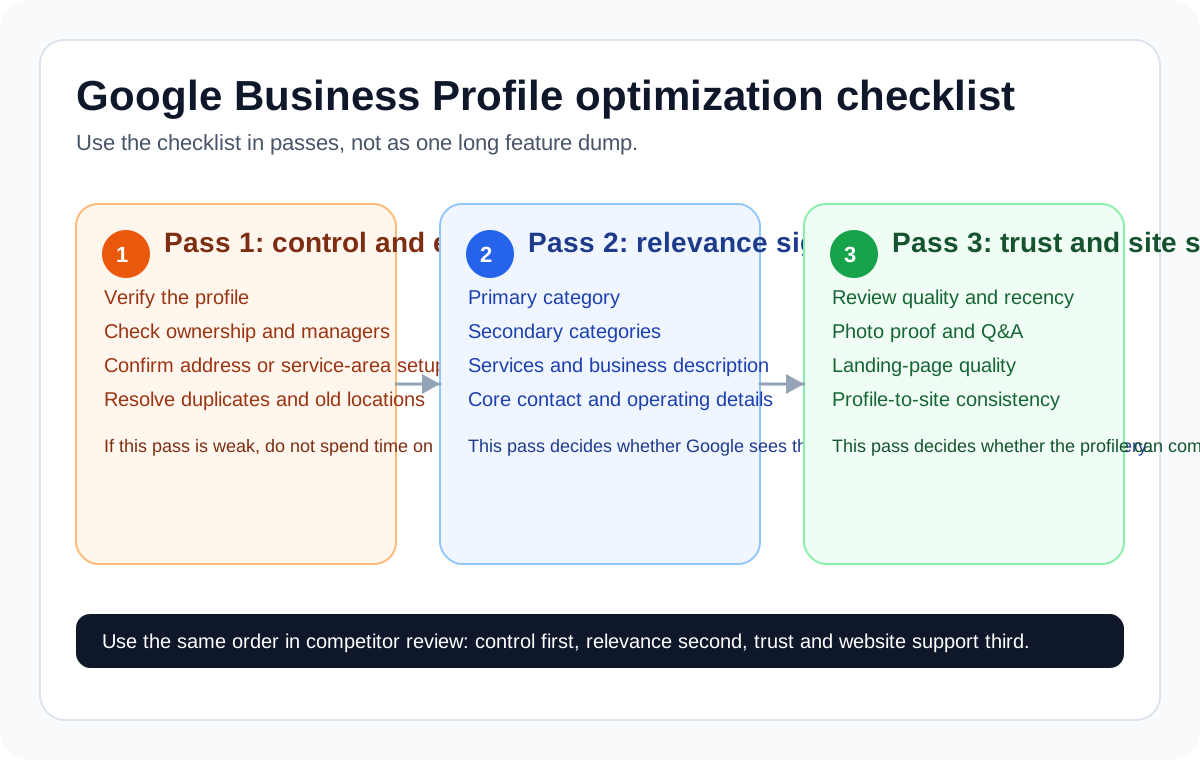
Use the checklist in three passes:
- confirm the profile is eligible and stable
- tighten the fields that affect local relevance
- strengthen the trust and website signals around the profile
That sequence keeps you from wasting time on optional features while the actual ranking constraints stay untouched.
The framework I use to keep the checklist practical
I use this sequence because long profile checklists usually hide the only question that matters:
- what deserves attention first
If a profile is unstable, duplicated, or weak on category relevance, extra polishing work does not do much.
The checklist becomes more useful once you split it into three passes:
- control and eligibility
- relevance signals
- trust and website support
Pass 1: eligibility and profile control
If these are wrong, the rest of the checklist matters less.
1. Confirm the profile is verified and manageable
Check:
- the profile is verified
- there are no pending review issues
- the right owner and manager access are in place
- there is no unresolved ownership conflict
If the profile is unstable, under review, or half-managed by old accounts, start there.
2. Confirm the business is eligible as listed
Check:
- the address reflects a real customer-facing setup or a valid service-area setup
- the profile is not using a borrowed address
- the business name reflects the real business identity
- the listing type matches how the business operates
If this part is weak, the problem may be visibility or trust before it is ranking.
3. Look for duplicates or old listing history
Check:
- old addresses
- merged listings
- duplicate profiles
- rebrand leftovers
These issues distort local visibility and confuse the business owner because the profile may appear inconsistent from one search to another.
Pass 2: relevance signals that influence rankings
Many businesses leave easy gains on the table here.
4. Check the primary category first
The primary category deserves more scrutiny than almost any other field.
Check:
- does it match the main revenue-driving service
- does it align with the query you most want to own
- do the top competitors use a different category that fits better
If the primary category is wrong, many smaller improvements lose force.
5. Review secondary categories carefully
Secondary categories should expand the real service set, not clutter it.
Check:
- the added categories genuinely reflect real services
- they do not pull the listing toward irrelevant intent
- they help Google understand the breadth of the offer without muddying the main signal
6. Review the services listed in the profile
Check:
- the services reflect what customers actually buy
- the most important services are clearly named
- the service naming lines up with real search language
- the service set matches the landing page behind the profile
Profile copy and website copy need to support each other here.
7. Tighten the business description
The description should do a simple job:
- explain what the business does
- clarify who it serves
- reinforce the core service focus
It should not read like ad copy stuffed with keywords.
8. Check core contact and operating details
Review:
- business name
- address or service area
- phone number
- website URL
- hours
- holiday hours when relevant
This is basic work, but stale operating details create trust loss fast.
Pass 3: trust, proof, and conversion quality
Once the relevance fields are sound, the profile needs enough proof to compete.
9. Review the review system, not just the review count
Check:
- whether new reviews still come in
- whether reviews mention the right services
- whether the business replies consistently
- whether competitors are clearly ahead on review freshness or credibility
Review recency often matters more than businesses assume.
10. Add photo proof that reflects real work
Check whether the profile has:
- exterior photos
- interior or team photos where relevant
- recent work examples
- service photos that match the core offer
Old, generic, or low-effort images weaken trust even if the profile is technically complete.
11. Review Q&A, attributes, and other trust details
Check:
- whether the business has useful attributes enabled
- whether common customer questions are already answered
- whether the profile supports a buyer making a decision quickly
These details do not outrank the big factors on their own, but they help complete the trust picture.
What I fix early versus later in real profile reviews
This is the triage split I use when the profile has several issues at once.
| Checklist area | Fix early when | Deprioritize when |
|---|---|---|
| Verification and ownership | The profile is unstable, disputed, or still under review | Access is already clean and the profile is live |
| Primary category | The business is not ranking for the main money service | The category already matches the leading service closely |
| Landing page support | The profile points to a generic or weak service page | The page already supports the query clearly |
| Review flow | Competitors have fresher, stronger proof | Review quality and recency are already competitive |
| Posts and lighter features | Bigger relevance or trust problems still exist | The core profile and page support are already solid |
That sequence stops low-value activity from pushing higher-impact fixes down the queue.
The website belongs in this checklist
This is the omission I see most often in weaker Google Business Profile guides.
The profile does not rank alone.
The page behind it often determines whether Google gets enough support for the service intent.
12. Audit the landing page behind the profile
Check:
- the title clearly names the service
- the H1 matches the real offering
- the page explains what the business actually does
- local proof appears above the fold or early in the page
- the page has a clear next step for the user
If the landing page is generic, thin, or misaligned, the profile has weaker support than it should.
13. Check consistency between the profile and the site
Review whether the profile and site agree on:
- main service focus
- location details
- contact details
- service-area expectations
- business identity
If these signals drift apart, Google gets a less coherent picture of the business.
14. Check whether the site earns trust on its own
I would look for:
- proof of work
- clear service explanation
- local relevance
- trust signals
- easy contact paths
At that point, a local SEO consultant often adds more value than another profile-only vendor.
What I would deprioritize until the basics are fixed
Some profile features get too much attention too early.
I would not obsess over these while the bigger issues are still open:
- frequent posting without a clear ranking bottleneck
- decorative profile tweaks
- keyword-heavy descriptions
- endless experiments with secondary features
That work is fine later.
It rarely outranks a wrong category, a weak review base, or a bad landing page.
Two profile audit patterns I see repeatedly
These are recurring patterns, not borrowed case studies.
The profile is complete, but the service page is too generic to support it
The business owner usually says:
- the profile is filled out
- the photos are there
- the reviews are not bad
- the business still loses the local pack
Then the landing page turns out to be the weak point:
- the H1 is generic
- the page does not explain the service clearly
- there is little local proof
- the next step is weak
At that point, the checklist needs to leave the profile and touch the website.
The owner keeps polishing fields while the main category is still off
This happens when the profile looks active, but the main relevance signal is still blunted.
The business updates:
- photos
- posts
- attributes
- descriptions
But the primary category still does not match the service query that actually drives revenue.
That is why I keep pushing category review earlier than most checklists do.
A simple audit order for business owners
If I had 20 minutes to review a Google Business Profile, I would use this order:
- confirm the profile is verified and eligible
- check the primary category
- compare services and description with the core query
- review the landing page behind the profile
- compare review quality and recency with the top competitors
- check for duplicates, old locations, or ownership history
- review citations and public consistency only after the first six are clear
That sequence catches the biggest problems earlier.
When this turns into a broader local SEO issue
A Google Business Profile checklist is useful up to a point.
After that, the real problem usually sits in one of these areas:
- the business cannot rank broadly because distance is limiting the market
- the website is weak enough to drag the profile down
- duplicates, moves, or multi-location complexity distort the signals
- competitor strength is much higher than the owner assumed
That is when I stop treating the work like profile maintenance and treat it like local SEO consulting.
How this checklist connects to the next two questions
Once you finish the checklist, most businesses still need answers to two follow-up questions:
- am I dealing with a profile that is missing, filtered, or unstable
- if the profile is live, what is stopping it from ranking higher
That is why these pages belong beside each other:
- How to get your business on Google Maps
- Why your business is not showing on Google Maps
- Google Business Profile suspended vs not ranking
- How to rank higher on Google Maps
Use the trigger guides when a specific change caused the problem:
- Google Business Profile after a move or rebrand
- Google Business Profile duplicate listings
- Why Google reviews disappeared from a Business Profile
- Google Business Profile under review or unstable
If you want a fast self-serve diagnosis before changing the profile, use the free local SEO audit tool.
The strategic point
A Google Business Profile checklist should not be a museum of every field Google gives you.
It should help you decide what deserves attention before lower-value polish steals the time.
For some businesses the next move is category cleanup. For others it is the landing page, the review system, or the reality that the business is trying to rank far beyond where proximity will reasonably support it.
That difference separates a profile that looks complete from one that can compete.
FAQs
What is the most important part of Google Business Profile optimization?
The primary category is one of the most important fields, but it works with the rest of the system. Verification, service relevance, reviews, and website support all affect the outcome.
How often should I update my Google Business Profile?
Update it whenever operating details change, and review it regularly enough to keep hours, services, photos, and responses current. The right cadence depends on how active the business is.
Does a complete Google Business Profile guarantee better rankings?
No. A complete profile can still lose if the category is weak, the website support is poor, the competitors are stronger, or distance limits the market.
Should I optimize the profile first or the website first?
Usually the profile first for basic accuracy, then the website immediately after if the business is competitive. In many markets the strongest result comes from fixing both together.