Portfolio / QueryArc
Independent project · AI search research, methodology, and product thinking
QueryArc: an independent AI visibility research and product project
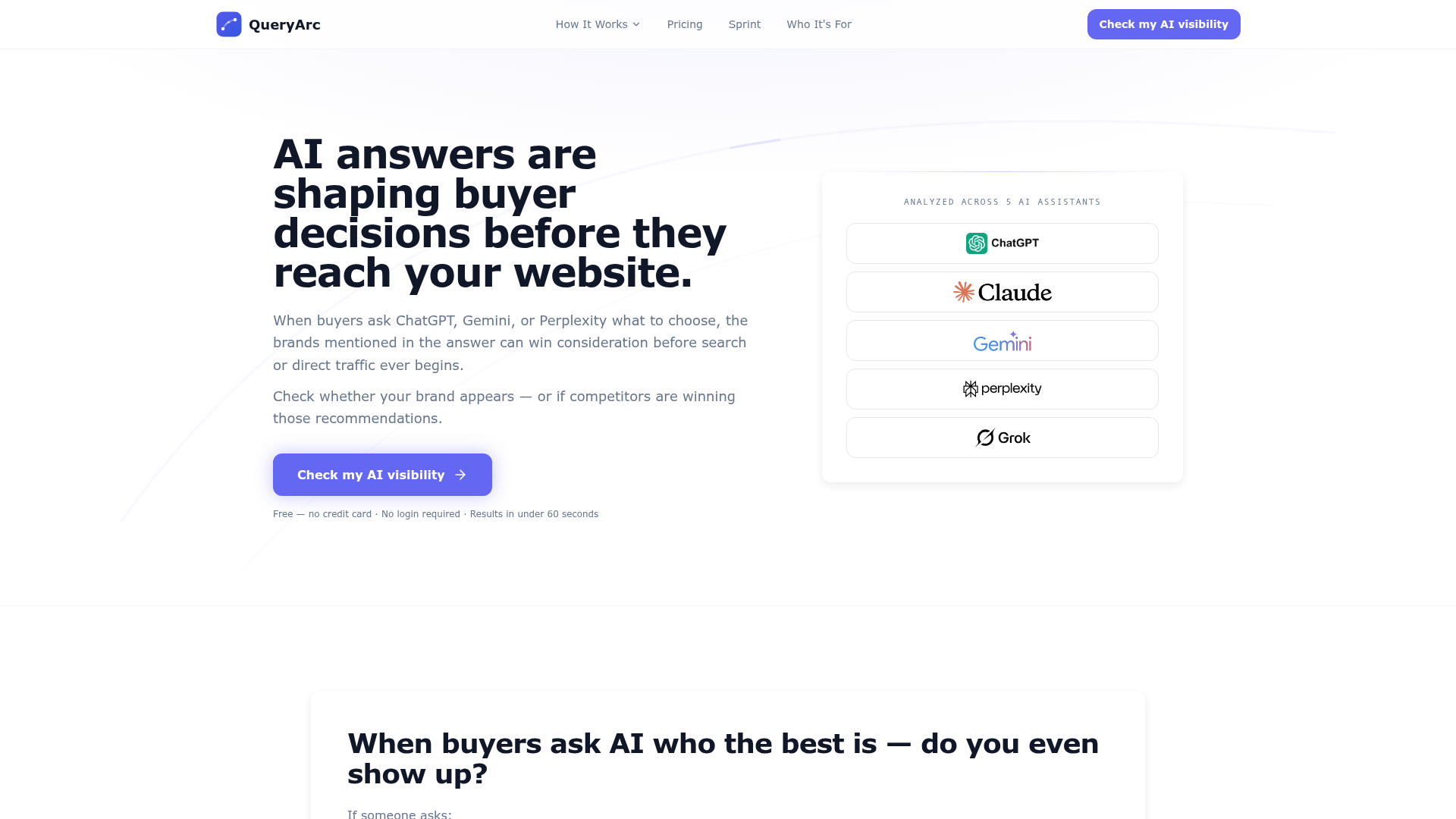
QueryArc is a personal project I developed to explore how brands appear in AI-generated recommendations. In simple terms, it tests whether a brand is mentioned, recommended, compared, or missed across buyer-intent prompts, then structures those outcomes through repeatable testing, rule-based scoring, and clear diagnosis. If you want the operating model behind it, read how to measure AI search visibility.
Independent project focused on AI visibility, repeatable testing, rule-based scoring, and structured diagnosis.
A project built around a real measurement problem
As AI-generated answers become a bigger part of discovery, brands increasingly need to understand whether they are visible in those responses, how competitors are appearing, and what is shaping those outcomes. That sounds simple, but AI outputs are not fixed. They vary by engine, by prompt, by repeated runs, and over time.
I developed QueryArc to explore that problem in a more disciplined way. Instead of relying on isolated screenshots or one-off observations, the project was built around controlled prompt sets, repeated runs, multi-engine testing, fixed scoring rules, and traceable reporting layers.
The goal was not to claim certainty where none exists. The goal was to create a framework that could make AI visibility more structured, more comparable, and more useful for practical interpretation.
QueryArc also reflects my growth approach: turning ambiguous market shifts into structured strategy, cross-functional execution plans, and measurable decision systems.
What QueryArc does
At its core, QueryArc is designed to answer a simple question: when someone asks an AI assistant who to choose, does your brand actually appear?
The system tests defined buyer-intent prompts across selected AI engines, checks whether a brand is included, recommended, compared favorably, or excluded, and then organizes those results into a clearer diagnostic view.
That means the project is not just about measurement. It is about turning messy, probabilistic AI outputs into something more interpretable.
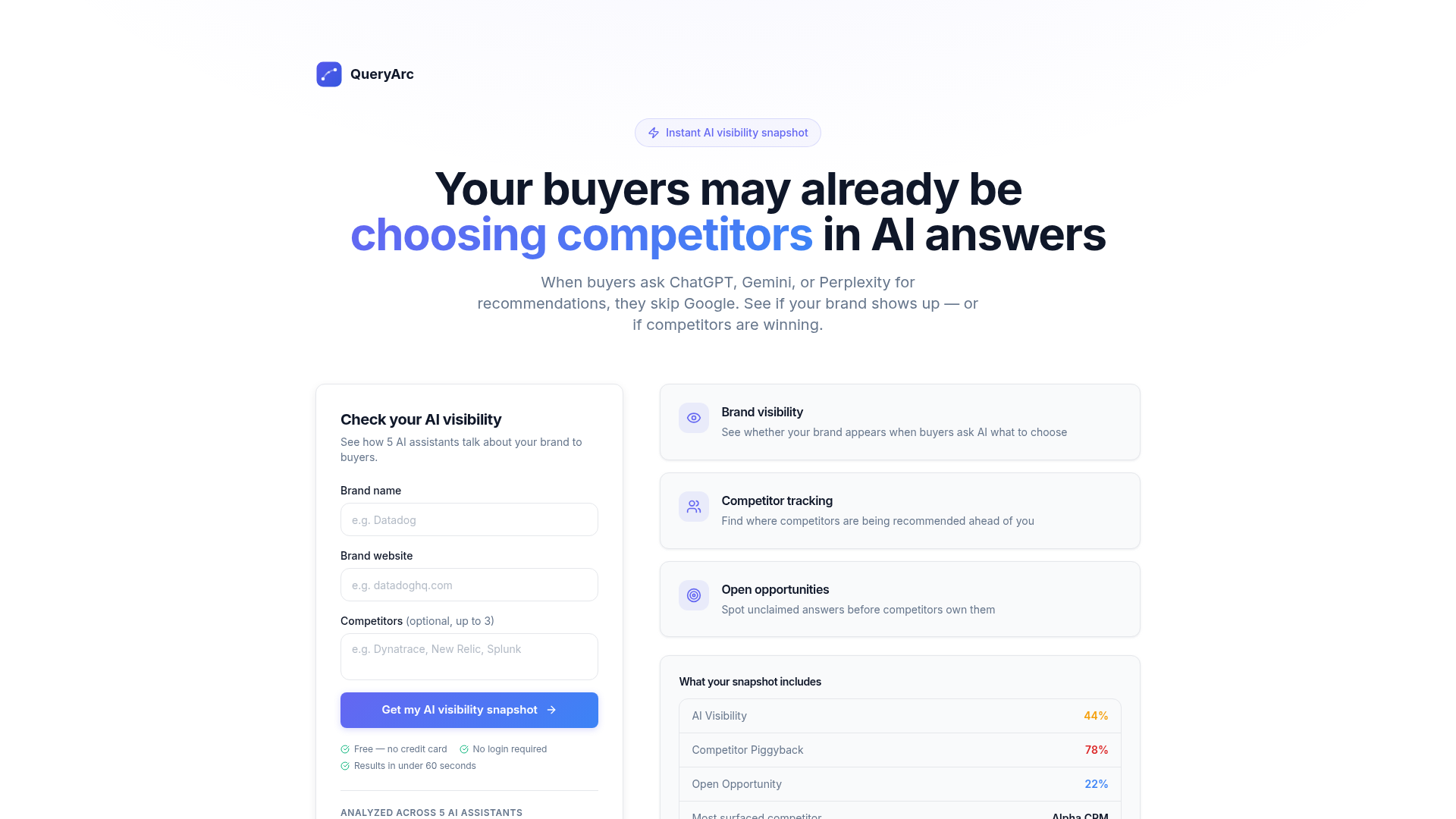
In practical terms, QueryArc shows
- Whether a brand is visible in AI-generated recommendations
- Whether competitors are appearing more often or more strongly
- Whether the brand is merely mentioned or genuinely endorsed
- Where outcomes differ by engine or by prompt
- What patterns may explain weak visibility or weak recommendation strength
The challenge QueryArc was built to solve
AI visibility is difficult to measure well.
A single answer from a single model does not tell the full story. Responses can differ across engines, repeated runs may produce different wording or different ordering, and many conversations around AI visibility still rely too heavily on anecdotal examples.
That creates a gap between interest and usefulness. Brands want to know how AI systems talk about them, but without a clear methodology, findings can become vague, inconsistent, or hard to compare over time.
QueryArc was developed to address that gap with a more structured and auditable approach.
What I developed
QueryArc was not just an idea or research exercise. I developed the project from concept through to a working tool and methodology. My work included:
- Defining the measurement problem the project would solve
- Shaping the product concept and user-facing logic
- Designing the audit methodology
- Structuring the controlled prompt framework
- Building the rule-based scoring approach
- Separating scoring from diagnosis
- Creating layered reporting for interpretation and traceability
- Building the working tool experience across different versions
The result was a project that combines AI search research, product thinking, measurement design, and practical reporting structure.
How the methodology works
The methodology was designed to make AI visibility measurement more repeatable, interpretable, and traceable.
Controlled question set
Each audit uses a structured prompt pack built around real buyer-intent queries. Prompts are clearly defined, versioned, stored, and reused for reruns. This helps prevent question drift and makes comparisons more consistent over time.
Multi-engine testing
Audits are run across multiple AI engines rather than relying on a single source of output. Results are reported separately at the engine level, so differences in behavior remain visible instead of being hidden inside one blended number.
Three runs per prompt
Each prompt is executed three times per engine. Because AI systems are probabilistic, repeated runs help reveal whether an outcome appears stable or inconsistent. This reduces the risk of drawing conclusions from a single response.
Rule-based scoring
Every response is evaluated using fixed detection rules. The scoring layer is deterministic and is not manually adjusted. That makes the output more consistent, more auditable, and easier to compare.
Metric calculations
Rates and percentages are based on a simple and transparent formula: matching runs divided by total valid runs. No weighted estimates, manual overrides, or hidden adjustments are applied.
Model-level and question-level reporting
The reporting structure was designed to show where patterns appear and where they differ. Outputs can be viewed through an executive snapshot, model-level breakdowns, question-level analysis, representative excerpts, raw outputs, and scored datasets.
Raw output traceability
Summary metrics are supported by representative excerpts and preserved raw outputs. This creates a clearer line between headline interpretation and the actual underlying model responses.
Human diagnosis framework
After scoring is complete, results are interpreted through a structured diagnosis layer. This diagnosis is used to explain likely patterns such as category association gaps, comparison weakness, endorsement weakness, ranking disadvantage, or signal insufficiency, but it does not alter the numerical results.
Stored run recipe
Each audit stores its configuration, including prompt pack, models used, and testing setup. This allows reruns to follow the same configuration and improves comparability over time.
Variance and limitations
The framework acknowledges that AI systems evolve and may behave differently across time. QueryArc was designed to reduce volatility, not eliminate it. The project does not claim ranking guarantees, privileged access, or manual control over model behavior.
Why this methodology matters
The most important part of QueryArc is not just that it produces a report. It is that the methodology tries to make a difficult problem more measurable without pretending to make it perfectly fixed.
That matters because AI visibility exists in an uncertain environment. Models change. Outputs vary. Recommendation patterns are influenced by multiple signals. A useful system has to respect that uncertainty while still giving people a structured way to observe patterns.
This is why QueryArc was built around repeatability, transparency, and traceability rather than hype. The project was designed to support clearer interpretation, not exaggerated certainty.
What this project demonstrates
For recruiters, hiring managers, or teams evaluating my work, QueryArc shows several things clearly.
Product thinking
I identified an emerging search problem, framed it clearly, and turned it into a usable concept.
Methodology design
The project required controlled prompts, scoring logic, reporting layers, and a clear distinction between deterministic scoring and human interpretation.
Modern search awareness
My work is not limited to traditional SEO alone. I also think about how discovery is changing across AI-generated answers, recommendation patterns, and answer visibility.
Hands-on execution
This was not only strategic thinking. I developed the project into a working tool and shaped how the system would function in practice.
The kind of work behind this project
QueryArc brings together several areas of work that sit at the intersection of SEO, research, and product thinking.
AI search research
The project explores how AI systems interpret, select, compare, and reuse information in recommendation-style answers.
Methodology and measurement design
The framework was built to make a fuzzy problem more structured through repeatable prompts, fixed scoring rules, reporting logic, and preserved traceability.
Query intelligence and interpretation
The work reflects a strong interest in how query framing affects answer patterns, visibility outcomes, and brand inclusion across different engines.
Product and systems thinking
This project required more than analysis. It required turning research into a user-facing system with clear logic, structure, and outputs.
How QueryArc connects to my wider work
QueryArc fits naturally with the rest of my work across technical SEO, content strategy, AEO, GEO, and AI-aware search thinking.
It builds on the same broader themes that already shape the rest of the site: structured discoverability, search behavior, answer readiness, content clarity, and the ways search is shifting beyond classic rankings alone.
What this page helps recruiters and hiring managers assess
If you are assessing fit for a role, QueryArc is useful because it shows how I work when the problem is new, ambiguous, and not already packaged into a standard SEO playbook.
It shows that I can think strategically, design a framework, define measurement logic, build practical systems, and stay grounded in methodological clarity. It also shows that I am comfortable working at the overlap of SEO, content, product thinking, research, and emerging AI-search behavior.
QueryArc project FAQs
Interested in how I approach modern search problems?
QueryArc is one example of how I think through evolving search behavior, structured measurement, and AI-aware discoverability. If you are hiring for a role that needs strategic clarity, hands-on execution, and a strong view of where search is heading, I'd be happy to talk.