Independent AI search assessment
AI search visibility audit for the questions your buyers actually ask
I assess whether your brand is included, recommended, or absent in answer-driven search, then trace the pattern back to the pages, proof, and technical signals that deserve attention. The output is a prioritized source-page plan, not a collection of screenshots.
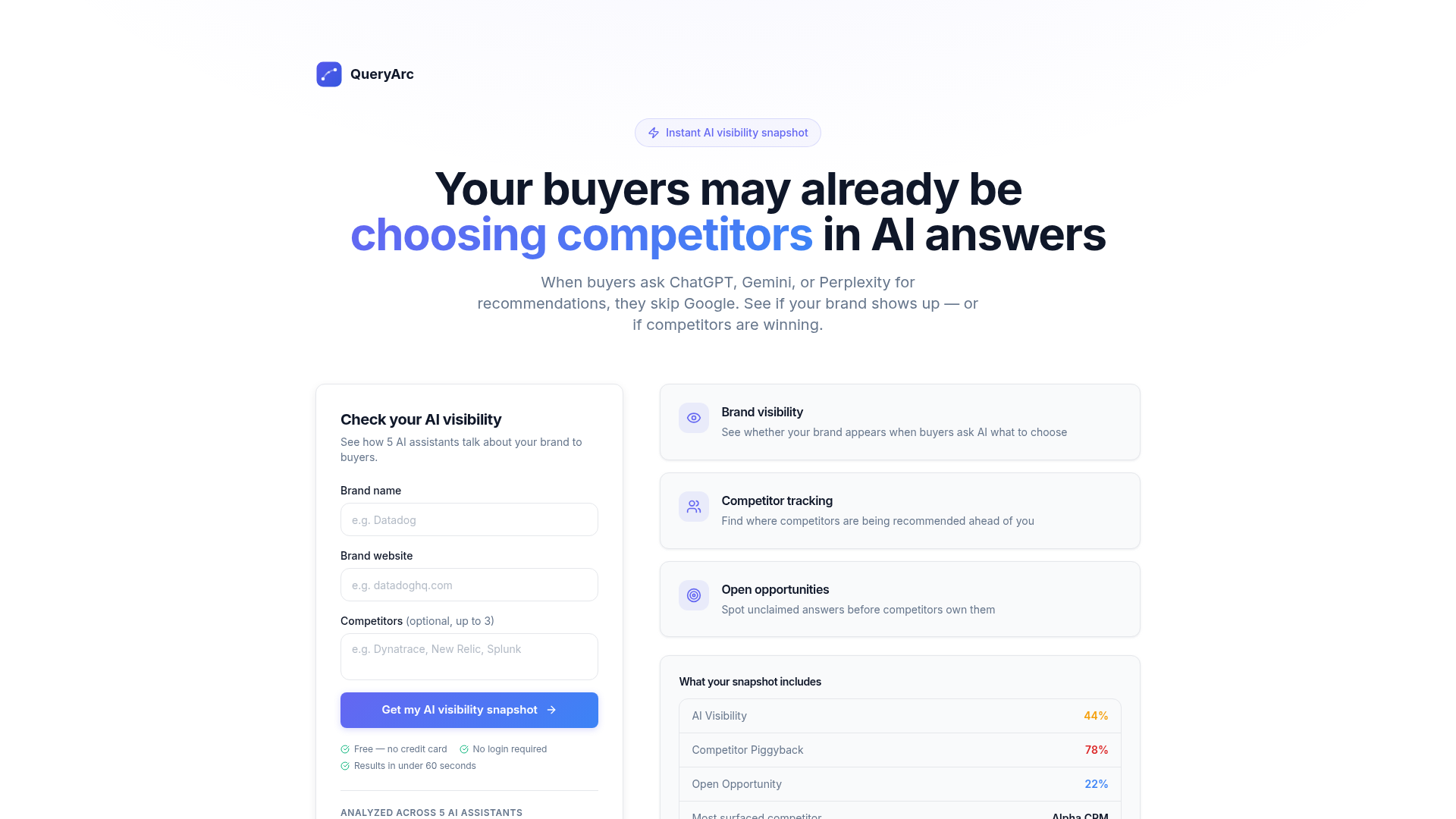
What an AI search visibility audit should answer
A brand appearing once in an AI answer is not a strategy. The useful questions are whether it appears for the right buyer intent, whether competitors appear more consistently, and which pages can become stronger sources for the next answer.
Best fit
Teams that need to understand whether AI-assisted discovery is affecting an important category, and which source pages should own the answer.
What I assess
Buyer-intent prompts, brand inclusion and recommendation context, named competitors, source-page support, page structure, proof, and relevant technical foundations.
What you receive
A documented prompt set, findings by question type, competitor context, source-page diagnosis, and a prioritized action plan instead of a screenshot collection.
The assessment method
Measure the pattern before changing the pages
I use a controlled method because answer-driven search can be volatile. The job is not to create a perfect score. It is to build enough evidence to make a better page and prioritization decision.
Define the buyer questions
I start with the category, problems, comparisons, and provider questions that can influence a qualified visit, shortlist, or conversation. A vague prompt set produces vague findings.
Test a repeatable prompt set
I use fixed prompts and repeat runs so a one-off mention does not get mistaken for a durable pattern. The question is whether the brand appears consistently, in the right context, against the right competitors.
Trace the result back to source pages
I review the service pages, comparison pages, proof assets, and support content that should make the brand easier to retrieve and explain. The result needs a page-level cause, not just a score.
Turn evidence into a ranked plan
The output is a short set of page, proof, internal-link, and technical priorities. I separate work that can influence the next iteration from work that is merely decorative.
Where the audit usually finds the real gap
- The site has no page that answers a commercial category question clearly enough to become the source.
- A service page explains the offer, but gives little proof, comparison context, or reason to trust the claim.
- Supporting articles exist, but their internal links do not reinforce the page that should own the topic.
- Important copy is buried, overly abstract, or missing from the rendered HTML that search systems can retrieve.
- The brand is being measured against generic prompts instead of the questions that lead to a shortlist or a conversation.
What I will not claim
I will not promise a citation in ChatGPT, a fixed share of AI answers, or a single score that pretends every engine behaves the same way. AI results change with prompts, models, locations, time, and the sources the system selects.
The useful result is more grounded: a repeatable measurement method, a clearer picture of the gap, and a shorter set of changes that can make the right pages more useful and easier to select.
Proof and next steps
The audit is a starting point. These pages show the methodology, the supporting content, and the type of source-page work that follows the diagnosis.
AEO and GEO consulting
Use this for the broader strategy and source-page work that follows once the audit identifies the real opportunity.
Explore AEO and GEO consultingHow to measure AI search visibility
A practical explanation of repeatable prompts, competitor context, and what weak measurement usually gets wrong.
Read the measurement guideQueryArc methodology
The project that turns AI-visibility discussion into a clearer question set and a tighter source-page action list.
Explore QueryArcBefore you commit
How to judge an AI search visibility audit before you buy one
A useful audit should connect evidence to buyer questions and source pages. If it only shows brand mentions, it has not yet told you what to change or why.
What the engagement includes
Prompt and competitor framing, repeatable checks, source-page review, technical and structural context, and a short action plan for the pages that matter most.
How I prioritize
I start with buyer questions close to revenue, then rank gaps by evidence, page ownership, implementation effort, and the value of becoming a stronger source.
What deliverables look like
A clear prompt methodology, findings by intent, page and proof recommendations, internal-link opportunities, and implementation notes where the site needs more than copy changes.
What outcomes matter
Clearer visibility patterns, stronger source pages, better evidence for what to fix next, and fewer AI-search decisions made from anecdotes or one-off prompts.
What not to expect
Guaranteed citations, a single universal score, or a claim that schema, llms.txt, or any one tactic can force an AI engine to recommend a brand.
AEO and GEO consulting
Use this for the broader strategy and source-page work that follows once the audit identifies the real opportunity.
Read guideHow to measure AI search visibility
A practical explanation of repeatable prompts, competitor context, and what weak measurement usually gets wrong.
Read guideQueryArc methodology
The project that turns AI-visibility discussion into a clearer question set and a tighter source-page action list.
Read guide
Written and delivered by Umair Salahuddin
Independent SEO, AEO & GEO consultant with hands-on ownership of organic growth for SaaS, eCommerce, and multilingual sites — and builder of QueryArc, an AI-visibility measurement methodology. No outsourcing, no junior handoffs: the person you talk to is the person who does the work. More about me · LinkedIn
FAQs about AI search visibility audits
What is an AI search visibility audit?
It is a structured assessment of whether a brand appears, is recommended, or is absent across the buyer questions that matter in answer-driven search. I connect the findings back to the pages, proof, and technical signals that can be improved.
Which AI search engines do you assess?
The engine set depends on the market and buyer behavior. I typically consider the answer-driven environments that are relevant to the category, then use a consistent prompt set rather than treating one screenshot as evidence.
Can you guarantee citations or recommendations in AI answers?
No. AI answers vary by engine, prompt, time, market, and source selection. The useful work is measuring the pattern, strengthening the source pages, and deciding which changes deserve attention first.
Is this separate from technical SEO?
No. The audit includes the technical and structural conditions that make a page easier to retrieve, understand, and trust. If those foundations are weak, the next step may be technical SEO work before further AI-search measurement.
Need a clearer view of where your brand appears in AI search?
Send the category, market, and buyer questions that matter. I will help you decide whether an AI visibility audit is the right starting point, or whether the real problem sits earlier in technical SEO, content, or proof.